002 – Universities Great Lessons
What term one has taught me
Uni, wow. What a ride.
I wanna begin by saying, all you 18-year-olds out there who went straight into a degree, while finding yourself and doing the social thing – I salute you. I do not know how you managed that without having a menty B.
I feel that asking kids of 18 to find what they want to do at that age is diabolical. It’s such a big expectation. That’s why so many kids just copy what their parents do, because it’s the easy route out. Yet 25 years later, they find themselves miserable, unfulfilled.. and wondering why.
That’s not everyone’s story – I appreciate that.
And mine is quite different.
At 18, I wasn’t really in a fit state to go to uni. I’d only just found a shred of confidence back in college after being so bullied in school. So the idea was not only daunting, but I wasn’t 100% sure what I wanted to do.
I remember the day I decided to tell my family I wasn’t going. I was so scared. But they were understanding and supportive. They reminded me that the decision wasn’t a forever one. Perhaps it’s just not for now.
And I think that’s actually my first lesson from uni – you don’t have to know what you want at 18. There are other options.
I threw myself into the world of employment instead. I’ve done so many jobs in my life and gained a huge skillset and lots of experiences along the way. Since finding coaching, I’ve toyed with the idea of going to uni, but it never felt like the right time.
Until this year.
Looking back, I think I needed all of those years in between. I needed to work, experience different environments, meet different people, figure out what I liked and didn’t like, and ultimately find my way to psychology from a completely different direction.
So perhaps it wasn’t that I was behind. Perhaps I just wasn’t ready yet.
I definitely think I romanticised the idea before going. I imagined strolling into lectures, soaking in knowledge about psychological approaches and living my best life. Honestly, I did. What I failed to consider was the reality – the boring parts, the academic writing and referencing, data, deadlines.
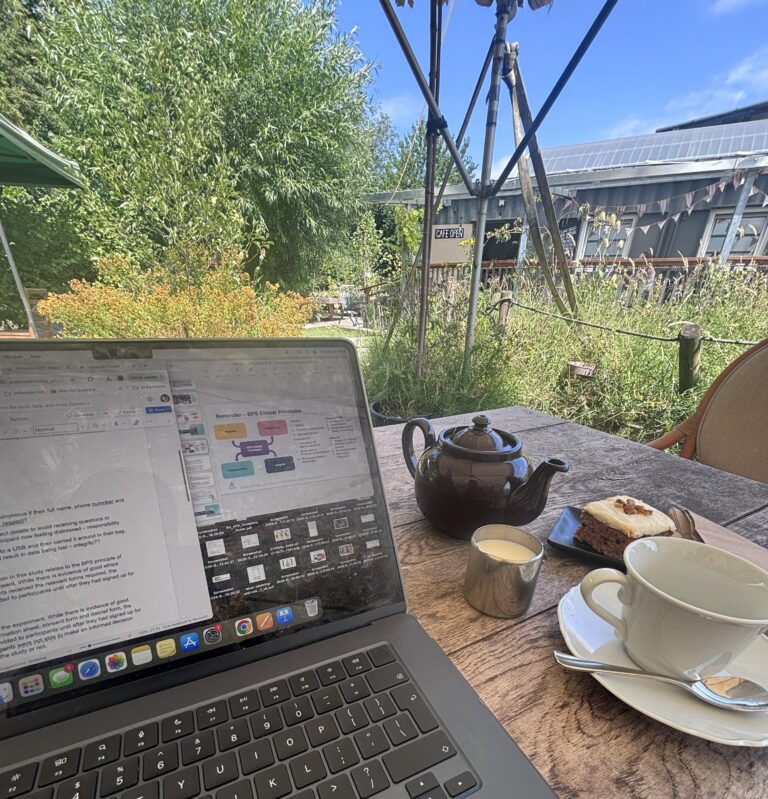
Naturally, my first term quite literally chewed me up and spat me out. Having been out of formal education for 10 years, it was a shock to my system. The first few weeks I was a literal deer in headlights. Complete survival mode. I’d just started at the cafe too, while winding down my property work, then uni on top. It was very full on.
I was being hard on myself and had a big weight on my shoulders.I felt stupid most of the time. Frustrated. Like I had no idea what was going on. Everything was moving very fast.So yes, naturally, I had two major wobbles, threatening to drop out while my poor bestie was doing her best to reassure me it would all be ok.
But this is the funny thing about a fixed mindset and a growth mindset, isn’t it?
I started out with a woe is me attitude.
I don’t get it. Why do we need to do that?
And slowly, that started to shift into:
How can I get my head around this? What do I need to make myself more comfortable with this?
I booked onto some workshops with the uni and, in a bish bash bosh, I slowly started to understand what academic writing actually means. And with more understanding came more clarity. And with more clarity came me feeling more relaxed.
So I think lesson number two is this: being a beginner is fucking uncomfortable & can happen at any stage in life – but you can learn how to learn.
I didn’t suddenly become cleverer. I just stopped expecting myself to understand everything immediately and started figuring out what I actually needed in order to understand it.
The thing is, I’m a fackin Virgo. I’m a perfectionist by nature.
Along with so many other things in my life at the moment, I’m being taught to let go.
Let go of getting the best grade possible. Let go of knowing all the answers. Be comfortable with a lack of understanding. Have confidence that this first year is my year to get it messy, get it wrong and build the foundation of my degree. And guess what?
I got a 2:1 on my first assignment!
Not bad for a first messy attempt – I honestly didn’t expect it.
And actually, I think that’s the third lesson.
Perfectionism and doing well are not the same thing.
I don’t need to be the good girl. I don’t need to be the perfect student, be on time or attend every lecture just because that’s what a good student is supposed to do.
It’s funny how much I’ve observed my inner child – little T, coming to the surface during classes. One day, in a class I found boring, I was having an inner dialogue with her in my head. The reality was, I wasn’t getting much out of the class at all.
So, to say no to little T, I walked out of class. Big T needed a rest.
A rest would be better for me than forcing it to look good. And I think that’s something I’m learning beyond university too.
Sometimes doing the right thing for yourself doesn’t look particularly impressive from the outside.
Sometimes it looks like leaving the class.
It looks like not getting the best grade.
It looks like admitting you don’t understand something.
It looks like letting yourself be a bit shit at something while you learn.
And then there’s probably my favourite lesson of all. Psychology is ultimately teaching me how to articulate myself better. How to think more critically. It’s helping inform how I want to show up differently. But most of all, it’s helping me to mix my woo woo with the science. And honestly, that’s ultimately what I went there for.
I don’t want to choose between the two.
I want to understand the science, question things, think critically and be able to articulate why I believe what I believe – while still leaving room for intuition, spirituality, self-exploration and all the things that have shaped me.
Maybe that’s the fourth lesson.
Learning something new doesn’t mean abandoning everything you already know. Sometimes it means finding a way to bring the two together.
And perhaps that’s what university is really teaching me so far.
Not just psychology, academic writing, referencing a bloody journal article.
But how to be a beginner again.
How to ask for help, tolerate not knowing, be patient.
But most importantly, how to allow new knowledge to expand my worldview rather than replace it.